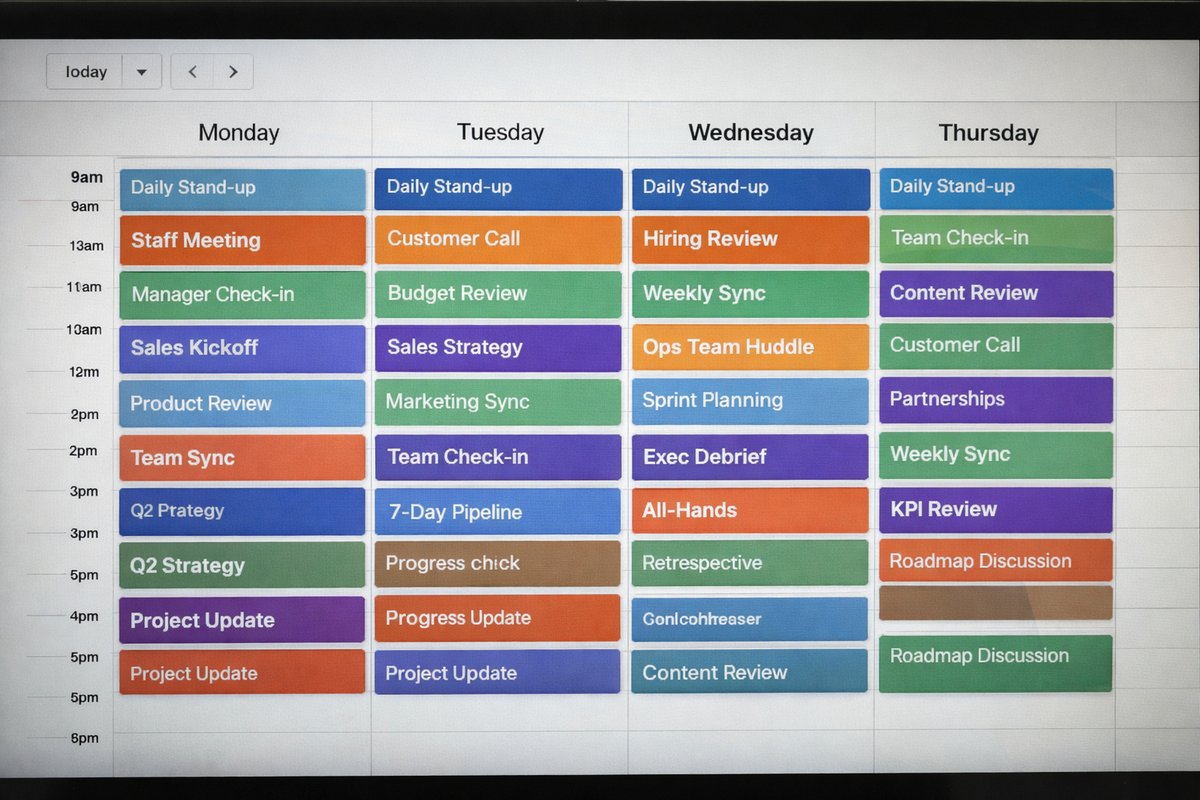
Count the meetings on your calendar this week.
Now ask yourself: how many of them will produce something? Not "information was shared." Not "we aligned." Something real. A decision. A plan. A problem solved.
If you're honest, the number is small.
Most meetings exist because someone, at some point, decided there should be a meeting. Nobody designed it. Nobody asked what it was supposed to produce. Nobody evaluated whether it was worth the time of everyone sitting in the room. It just got put on the calendar, and it's been there ever since.
Multiply that by every team in your company. That's where the energy goes.
The meeting problem isn't time. It's design.
When founders complain about meetings, they usually frame it as a time problem. "We spend too much time in meetings." So they try to fix it by making meetings shorter. Or having fewer of them. Or declaring "meeting-free Tuesdays."
That's like fixing a bad restaurant by making the portions smaller.
The problem isn't that you have too many meetings. The problem is that nobody designed them. They have no clear purpose. No structure. No way to evaluate whether they worked. They just happen, week after week, consuming time and energy while producing nothing but the vague sense that everyone is "staying informed."
Staying informed is not an outcome. It's an excuse for a meeting that has no purpose.
Ceremonies are different
For millennia, humans have used ceremonies to get important things done. Marriages. Courtroom proceedings. Military formations. Religious services. These aren't just traditions — they're carefully designed rituals that produce specific outcomes reliably.
A ceremony has structure. It has roles. It has a pattern that everyone knows. And it has a purpose that's clear before anyone walks in the room.
Think about the difference:
A meeting is scheduled because someone thinks people should talk.
A ceremony is designed because something specific needs to happen.
Designing new ceremonies is one of the most important and overlooked responsibilities of leadership. It is, after vision, the key responsibility. Providing your team with a framework to be successful and embedding it naturally into the daily rhythms of work.
The three questions
Here's a simple test for any recurring meeting in your company. Ask the participants three questions after it's over:
Purpose: Did we accomplish purposeful work?
Presence: Was it worth the time and effort required from each person to be there?
Passion: Do people leave with positive energy? Will they naturally keep showing up?
All three have to be true. Not one. Not two. All three.
If participants don't feel a sense of purpose, presence, or passion for the ceremony, something needs to change. Either the ceremony evolves until it works for everyone, or it shouldn't exist.
Apply this test to your next weekly status meeting. I'll wait.
What a real ceremony looks like
A marketing entrepreneur named Gary had a weekly status meeting with his senior team. The usual kind — people reporting on what they were doing, slides getting shared, everyone pretending to pay attention.
When we looked at it together, we made a simple change. Instead of status reports, each person selected three evidence-based metrics tied to the company's vision. They tracked them, charted them, and reported on them during what we renamed the "Heartbeat" ceremony.
The flow improved. But something was still off. Gary wasn't happy, and it took a conversation with his brother Todd — the company president — to figure out why.
Turns out, Gary had one very specific question he needed answered every week. A question that any founder who pays employees first and himself last would understand:
"Am I going to get paid this week? And how much?"
The answer was technically buried in the financial data. But looking at the numbers, doing the calculations, and guessing wasn't an emotionally satisfying experience. By making the question and answer an explicit part of the ceremony, they eliminated both guessing and surprises.
That's ceremony design. You find out what actually matters to the people in the room, and you build the structure around it.
The weekly status meeting is killing you
Let me describe a meeting you probably have.
It's an hour. It's on the calendar every week. People go around the room giving "updates." Half the room is checked out because the updates don't apply to them. The other half is anxious because their update isn't ready. Nobody makes a decision. Nobody leaves with more energy than they walked in with.
Sound familiar?
Now imagine replacing that with a ceremony that takes 15 minutes. The team reviews one or two goals and rates their confidence on a scale of 1-5 that they'll hit them. Anything below a 4 gets discussed — briefly. Open action items get checked. People share only what's interesting or useful. If a topic needs more time, it goes in the "parking lot" for a smaller group to handle.
Seven people. Fifteen minutes. Everyone walks out aligned.
That's not a meeting. That's a daily check-in ceremony. And it works because someone designed it.
How to start
You don't need to redesign every meeting tomorrow. Start with the one your team dreads the most. The one that makes people sigh when it shows up on the calendar.
Ask yourself:
What is this supposed to produce?
Who actually needs to be here?
What's the pattern — the steps that happen every time?
How does this connect to our mission?
And what triggers it — does it need to happen on a schedule, or only when something specific occurs?
Write that down. Run it once. Then ask the three questions: purpose, presence, passion.
Iterate. Adjust. Run it again.
When we introduced a full set of new ceremonies at a company called Interface Systems, the team said afterward: "We accomplished more in a week than we usually do in months." And: "It was fun."
Fun. At work. In a meeting.
That's what happens when someone designs the ceremony.
Watch: The Worst Meetings Ever
Meetings are where energy goes to die.
Ceremonies are where it comes back to life.
The difference is intention.