I've been watching companies break for over two decades.
Not dramatically. Not in a single moment. More like a slow leak. The kind where you don't notice the tire is flat until you're already driving on the rim.
Here's the pattern.
A founder starts a company. Small team. Everyone knows what they're doing and why. Decisions happen fast. Trust is high. The culture is electric.
Customers come in. The company grows. New people join. Departments form.
And then, slowly, the thing that made the company great starts to disappear.
The founder usually notices it as a feeling first. Something is off. Meetings are multiplying. Decisions that used to take five minutes now take five weeks. The best people are going quiet. There's a heaviness that wasn't there before.
The instinct is to blame someone.
Maybe it's the new VP who brought "process" from their last company. Maybe it's the middle managers who are building little empires. Maybe the early employees have gotten lazy.
Here's what I've learned: it's almost never a people problem.
The system is doing exactly what it was designed to do. You just never designed it.
Culture is a system
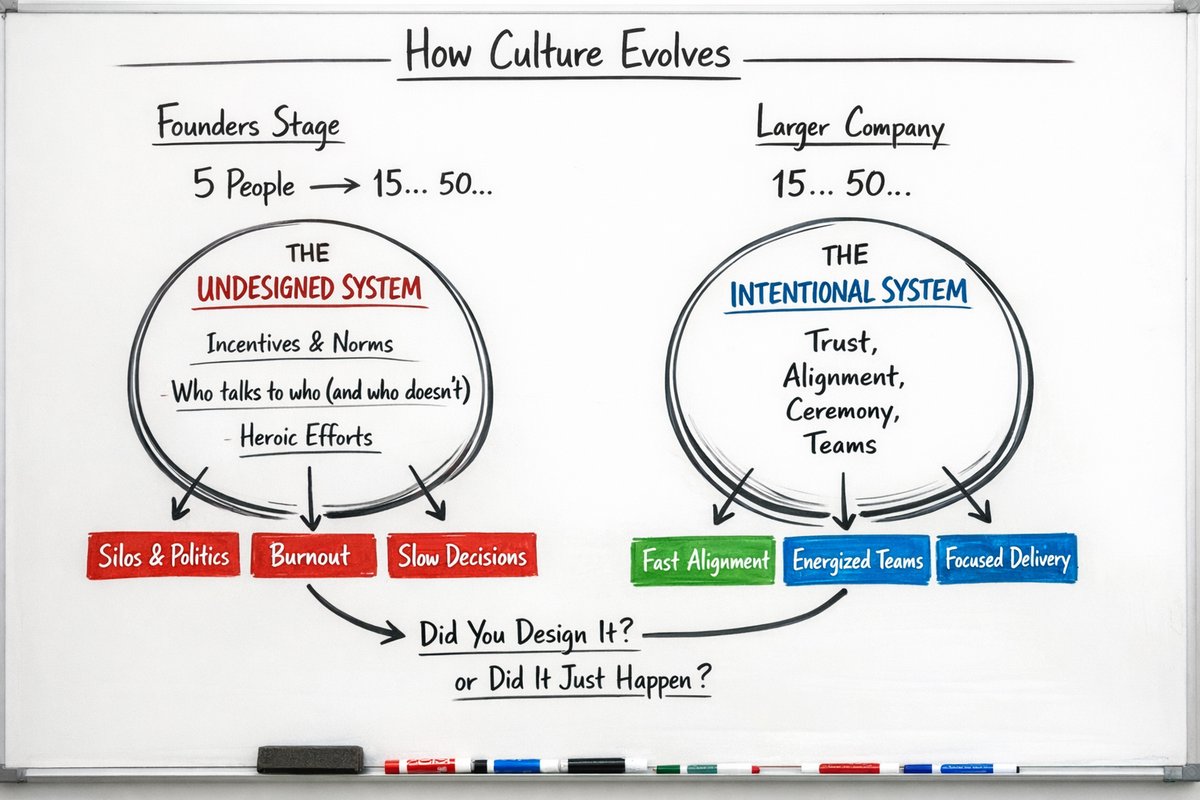
Every company has a culture. It either emerges by accident or gets built on purpose.
When you were five people in a room, the culture designed itself. Everyone could see everyone. Trust was built through proximity. Alignment happened through osmosis. You didn't need a mission statement because the mission was obvious — survive and ship.
At fifteen people, that starts to stretch. At fifty, it breaks.
Not because anyone did anything wrong. Because the informal system that created your culture was never designed to scale. It was an accident that worked — until it didn't.
The Businessland lesson
There was a company called Businessland. In the 1980s, it was the dominant force in the microcomputer sales industry. Blue-chip clients. Top talent. Mentioned four times in Tom Peters' Good to Great. The culture was exceptional.
What most people didn't realize was that the culture was built by one person — the co-founder, Enzo Torresi. The CEO, David Norman, was good at the mechanics of running the business. But Enzo was the heart. He created the environment where people did their best work.
When Enzo left the company, Businessland collapsed with breathtaking speed. The CEO, believing the company's reputation was so strong he could cut top salespeople's commissions by a third, said in a meeting: "We could tie an order pad to a monkey and send them out to get sales."
Within weeks, every top salesperson was gone. Their clients followed. The company that Tom Peters had celebrated was finished.
The lesson isn't that Enzo was irreplaceable. The lesson is that he never institutionalized what he built. The culture depended on his presence. When he left, there was nothing holding it in place.
The alternative
Cultures can be designed independently of the natural proclivities of any individual leader.
That sentence is worth reading twice.
It means you can build a culture that survives leadership changes. That scales past the founder's ability to be in every room. That doesn't depend on one person's force of will to keep it alive.
But it requires intention. You have to decide what your culture is before it decides for you.
This means getting clear on a few things:
What's the mission? Not the one on the wall. The one people actually use to make decisions.
What are the values? Not aspirational posters. Operating principles that guide behavior when things get hard.
How are teams structured? To deliver value, or to preserve hierarchy?
How do people work together? Through meetings that drain energy, or through ceremonies that create it?
The system is the solution
Most companies try to fix culture by changing people. Better hiring. Better training. Better incentives. Better messaging.
But behavior follows the system. Always.
If the system rewards politics, you'll get politics. If the system rewards heroics, you'll get burnout. If the system rewards silence, your best ideas will never surface.
If you want a different outcome, change the system.
Not with a reorg. Not with an offsite. Not with a motivational speaker.
With intention.
Watch: Continuous Improvement Sucks!
Nothing is broken. Your company is producing exactly the culture its system was designed to produce.
The question is: did you design it?
Or did it just happen?